|
Dispatches from Scandinavia
We live in a swim of images. Not merely do the big agencies receive more than 12,000 images daily, the photography schools produce more and more good photographers and photojournalists who compete for fewer places in print and contribute to that flow. There are also more non-traditional venues to view pictures and to make an impact with photography, namely photography festivals.
A cluster of such festivals took place in Northern Europe recently. Dokument 05 is an annual meeting and workshop of three top Scandinavian photography schools. World Press Photo held its 50th anniversary celebration and party, and the Dutch photography festival, Noorderlicht, followed up last year’s wildly successful show of photography from the Arab world, “Nazar,” with the more enigmatic theme of “Traces and Omens.” At the same time, another loosely themed show, Backlight 05, was held in Tampere, Finland, which celebrated its own photography festival, a more art-oriented venture co-sponsored by the British Council and Gallery Hippolyte.
It is important to look at Dokument 05 as an opportunity to bring young Scandinavian photographers together with others from around the world for workshops and slideshows in order to compare notes and to network. The students are exposed to such heroes as Anders Petersen and Jan Grarup, Antonin Kratochvil, Paolo Pellegrin, Heidi Bradner, Shahidul Alam, KB Nøsterud, and Pieter Ten Hoopen. This year’s event was held in Oslo, Norway, under the auspices of Per-Anders Rosenkvist of the photojournalism programme, Oslo University College. Each of the schools works closely with local papers and magazines and has international projects and outreach programmes. In short, Dokument functions as a miniature version of World Press Photo’s Joop Swart Masterclass and its travelling projects. Work presented ranged from classically conceived imagery, beautifully framed, by Petersen and Grarup to more experimental work by Nøsterud, and Ten Hoopen.
Not surprisingly, many of these students have gone on to win may prizes including Erik Refner, a graduate of the Danish school in Arhus, who won the World Press Photo of the Year in 2001. Now in its 50th year, Amsterdam based World Press Photo took the occasion to stage both a birthday bash and a colloquium on the state of the industry. Journalists, editors and agency directors bounced around ideas concerning the demise of opportunities for publication, the effects of the consolidation of the agencies, the impact of digital on photography and its implication for photojournalism. There were many “graveyard speeches”, as Agence Vu’s Christian Caujolle put it, “it’s not photojournalism that’s sick, it’s the media.”
A commemorative photography show, Things As They Are, curated by Caujolle at FOAM, the Foto Museum Amsterdam, runs until 7 December and tracks the reduction in space available to photojournalists in the major weeklies, which shrank from eight or more spreads in 1950s and ’60s to the two or three permitted today. As is obvious, journalists are increasingly forced to seek other opportunities for their work to reach the public, whether through gallery representation (albeit rather unlikely when subject matter may include images of violence or despair), books – a trade-off from 2.5 million readers for Paris Match versus 2,000 copies of a monograph, and, increasingly web-based distribution outside of the agencies. The latter will become increasingly important as competition gets tougher.
|
There was also the presentation of a stamp set commemorating 50 years of World Press Photo prize winners and an admonition, testifying to the strength of imagery, by Jan Pronk, special representative of the UN Secretary General for Sudan, decrying late coverage of Darfur, for photographers to go out and take pictures of situations before they get out of control and end up on CNN, the BBC, or Al-Jazeera.
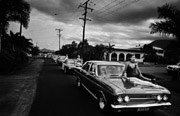
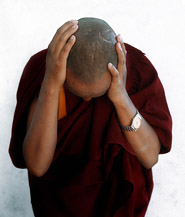
On a different note, this year’s 12th incarnation of Noorderlicht, the Dutch photography festival held this year in Groningen, situated documentary and art photography in a context that tested what could and could not be seen, and invoked photography’s claim to truth and its ability challenge the imagination. Under the rubric of “Traces and Omens” curator Wim Melis presented a shaggy dog of a programme that nonetheless brought out the power of documentary and reportage photography. Works like Christophe Agou’s post-9/11 imagery from his birth region in France seemed to be a celebration of the simple things in life whereas Pep Bonet’s searing work from post-conflict Sierra Leone was a testament to the effects of man’s brutality to his neighbors. Paula Luttringer returned to the prisons of Argentina where she was held during that country’s “Dirty War” of the 1970s and ’80s and depicted the traces of things that kept her and her fellow prisoners alive and sane during those terrible years. Paul Fusco’s return to Chernobyl 20 years later was a haunting reminder of the effects of invisible radiation made all too painfully visible to the survivors and their children. Australian Trent Parke presented a dark body of work that appeared to mirror the newly doubtful and uncertain side of “the lucky country” in the wake of bombings in Bali, fires, and droughts. Joakim Eneroth portrayed Tibetan monks and nuns with the torture implements they faced in Chinese prisons. He also presented an enigmatic, Sugimoto-like series of seascapes, “Waiting”, that addressed, on a metaphorical level at least, the implications of the earthquake and tsunami that devastated Indonesia and neighbouring countries.
If these works presented a more or less directly metaphorical use of documentary photography, one that hinted or alluded to things, two other bodies of work took shots at the truth claims of photography. Larry Fink’s German Expressionist tablseau of body doubles representing George W Bush, Donald Rumsfeld, and various corporate titans and cronies, many now in jail, amid a bevy of floozies, was originally conceived as a fashion shoot for the New York Times magazine and scheduled to run on 16 September 2001. Killed in the wake of 9/11, the “Forbidden Pictures” were unable to be presented in the United States for years. Michael Najjar’s project “Information and Apocalypse” from 2003 took potshots at a more literal if sarcastic meaning of “embedded” in his depiction of political control during wartime in an age of video games.
The works on the wall in Groningen and elsewhere make it clear that photography is a very slippery medium. Not all reportage tells a single story. No image can have a perfectly clear message. Sometimes the allusive is more powerful than the concrete. That master of images, Henri Cartier-Bresson, once re-titled his masterpiece, “The Decisive Moment”, for a friend thus: “Some Decisive Moments (maybe).” It is a most realistic statement to the power of images and the impossibility of representing truth faithfully. To quote Lewis Hine: “Photographs do not lie, but liars can make photographs.” We should be aware of these words both when we make an image and when we present it to the world. BK
|